
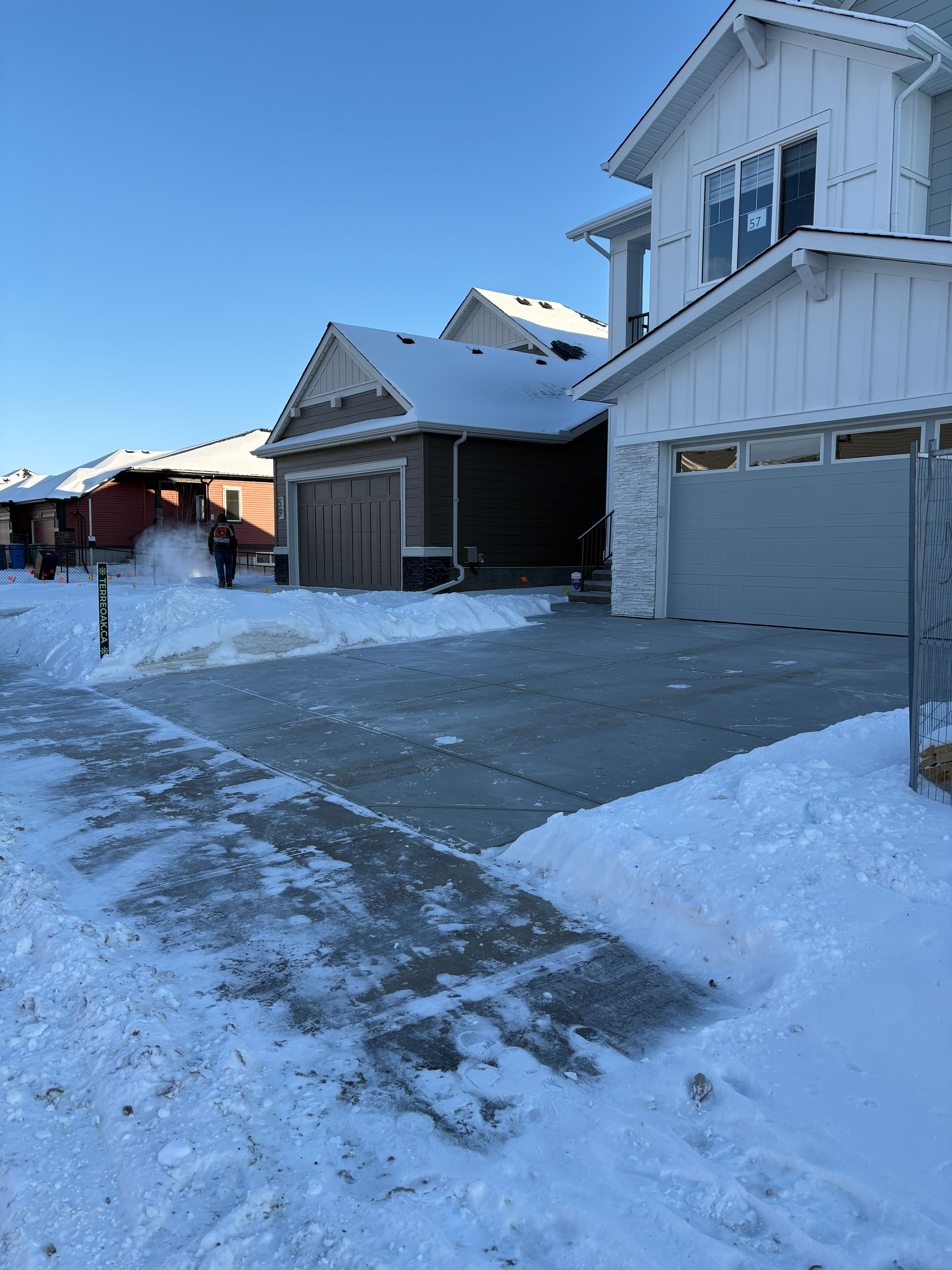
On a Calgary commercial property, ice control means choosing the right product for the temperature and applying it at the right moment. Rock salt works down to about −10°C, treated salts and chloride blends work in deeper cold, and sand adds traction when nothing will melt. The plan also has to cover re-freeze after a Chinook, which is when most slips happen.
Key takeaways
- Rock salt loses most of its melting power below about −10°C. Below that you need a treated salt or a calcium or magnesium chloride product.
- Sand and grit don’t melt anything. They add traction, which makes them the fallback in extreme cold.
- Pre-treating before a storm stops ice from bonding to the pavement and makes clearing faster.
- The riskiest hours in Calgary come after a Chinook, when meltwater refreezes at sundown.
- Entrances, ramps, stairs, accessible stalls and shaded north-facing areas need attention before open pavement does.
- More product is not better. Over-salting damages concrete, kills turf and plantings, and gets tracked indoors.
Why is ice a bigger risk than snow in Calgary?
Snow is visible. People slow down for it, and a plow deals with it. Ice is the problem that’s left behind, and Calgary makes more of it than most cities because of how often the temperature swings across zero.
A Chinook can take a site from −15°C to +8°C in an afternoon. Snow piles melt, water runs across the lot, and when the sun goes down it freezes into a clear sheet right where people walk from their cars. That cycle can repeat for days after a single snowfall, long after the plowing is finished.
That’s why a snow contract that only responds to snowfall leaves a gap. The ice shows up on days when it hasn’t snowed at all.
Salt, sand or ice melt: which product works when?
No single product covers a Calgary winter. Each one has a temperature range where it earns its keep.
Rock salt (sodium chloride)
Works: Down to about −10°C
The cheapest option and the standard for mild winter days. It slows to a crawl in deeper cold.
Treated or blended salt
Works: Colder than plain salt
Rock salt coated with a liquid chloride so it starts working faster and keeps working in lower temperatures.
Calcium or magnesium chloride
Works: Well below −10°C
Works in deep cold and acts quickly. Costs more, so it’s usually reserved for cold snaps and high-risk areas.
Sand or grit
Works: Any temperature
Gives traction but melts nothing. Needs sweeping up in spring and can clog catch basins.
A good contractor switches between these as the forecast changes rather than spreading one product all winter. It’s worth asking exactly what they use and at what temperature they change over.
When should ice control be applied?
- Before the storm. Pre-treating pavement stops snow and ice from bonding to it. The lot clears more cleanly afterwards and needs less product overall.
- After clearing. A light application once the snow has been pushed deals with the thin layer a plow or shovel leaves behind.
- When it refreezes. This is the visit that gets missed. After a melt, somebody has to come back in the late afternoon or evening and treat the areas where water has run.
- During freezing rain. Rare in Calgary, but the most dangerous condition there is. It needs treatment while it’s happening, not afterwards.
Which areas of a property should be treated first?
Open pavement in the sun usually looks after itself. The trouble spots are predictable, and they should be written into the site plan:
- Building entrances and the first few metres outside every door.
- Stairs, ramps and curb cuts.
- Accessible parking stalls and the path from them to the door.
- North-facing walkways and anywhere a building casts shade all day.
- Low spots and the area downhill from snow piles, where meltwater collects.
- Under downspouts and roof edges that drip onto walkways.
- Loading docks and garbage enclosures, where staff walk on packed snow.
Can you use too much salt?
Yes, and it’s a common mistake. Past the point where the ice has been dealt with, extra product does nothing except cause damage:
- Chlorides speed up scaling and spalling on concrete, especially concrete that’s only a year or two old.
- Salt that washes into beds and lawn edges burns turf and shrubs, and you see the result in spring.
- Granules get tracked into lobbies and onto floors, which is a cleaning cost and a slip risk of its own.
- Runoff carries it into storm drains.
The right amount is the least that does the job, applied evenly. If you’re seeing white crusts and piles of granules by the doors, too much is going down.
What should you ask your contractor about ice control?
- Is ice control included in the contract price, or billed per application?
- Which products do you use, and at what temperature do you switch?
- Do you pre-treat before a forecast storm?
- Do you come back for re-freeze after a Chinook, without being called?
- Are entrances, stairs and ramps treated by hand, or only the areas a truck can reach?
- Is every application logged with a time and photos?
Our property manager’s guide to snow contracts covers the rest of what to lock in, and our commercial snow removal page explains how we handle ice control on the sites we look after.
Frequently asked questions
At what temperature does rock salt stop working?
Regular rock salt loses most of its effectiveness below about −10°C. In colder weather a treated salt or a calcium or magnesium chloride product is needed, with sand for traction when nothing will melt.
Is sand or salt better for a parking lot?
They do different jobs. Salt melts ice within its temperature range; sand only adds traction. In deep cold sand is often the practical choice, but it has to be swept up in spring and can block drains.
What is pre-treating?
Applying a de-icing product to pavement before a storm arrives. It stops snow and ice from bonding to the surface, so the lot clears more cleanly and needs less product afterwards.
Why is my lot icy when it hasn’t snowed?
Usually re-freeze. During a Chinook or a sunny afternoon, snow piles melt and water runs across the pavement, then freezes when the temperature drops in the evening.
Does de-icing salt damage concrete?
It can. Chlorides speed up surface scaling, particularly on newer concrete, and over-application makes it worse. Using the least product that does the job reduces the damage.